
Dr. Prashant Kumar Jain
Principal - RJIT, Gwalior
Faculty Team Coordinator
Prof. Suhel Ahmed Khan (MCA)
Team Members
Prof. Abhay Tiwari (CE)
Dr. Namita Saxena (CHEM)
Dr. Rakesh Sohal (PHY)
Prof. Mugdha Shrivastava (ME)
Prof. Samiksha Khule (CSE)
August 20-25, 2025
August 2025
August 28-29, 2025
Early September 2025
Early September 2025
September 22-30, 2025
Late September 2025
September 5, 2025
September 15, 2025
September 16, 2025
Education plays a crucial role in a country’s development. The traditional approach of attending classes passively and focusing only on securing good grades has become outdated in today’s world. Every individual is believed to possess unique talents and characteristics, and the teacher’s role is to help students discover and nurture these abilities so they can achieve their goals. When inherent talent and core competencies are aligned, education becomes meaningful, holistic, productive, and fulfilling.
The purpose of an engineering college is not only to produce competent engineers but also to cultivate knowledgeable, well-cultured graduates who can share the essence of their learning and positively contribute to the nation.
About the Student Induction Program
The transition from school to college is one of the most significant and challenging phases in a student’s life. When students join an institution, they bring with them diverse backgrounds, experiences, and expectations. They step into a new and unfamiliar environment, often with limited knowledge about the institution they are entering. The Student Induction Program is designed to welcome these new students to higher education and prepare them for their new responsibilities. This induction program aims to help students integrate smoothly into the institution by providing essential information that enables them to settle in quickly. It supports their academic success by aligning their interests with the institution’s goals and helping them adapt effectively to their new surroundings.
Purpose of Student Induction Programme is to
As per the guidelines of AICTE 12 Weeks Induction Program was conducted for first semester students of the Academic year 2025-26. The details of the activities conducted and outcomes of the Induction program is presented in this report.
Activities conducted in the student induction program are as per the following modules which are prescribed by AICTE:
Orientation Program
Department's/College Orientation Program
An Orientation Program serves as a crucial foundational step for new entrants, acting as a carefully structured, multi-day process designed to facilitate a smooth and successful transition into a new academic environment, such as the one at RJIT. The primary objective is to acclimate participants by providing all necessary information, fostering a sense of belonging, and clearly setting expectations regarding the institution's culture, policies, and available resources.
For incoming students, the Orientation Program is an intensive deep-dive that goes far beyond general introductions. Participants receive detailed briefings on their respective academic departments, meeting key faculty and understanding the scope of their specific curricula. Furthermore, they are extensively educated about the central administrative and support functions essential for their academic life.
Examination Department Orientation Program
The sessions on the Examination Department's procedures and policies. The session conducted by the Examination Department focused on demystifying the academic evaluation process, ensuring students understood the system from day one. Key areas covered included:
Evaluation System: A detailed explanation of the internal assessment components, continuous evaluation procedures, and the weightage assigned to various tests, assignments, and practical sessions.
University Examination Rules: Comprehensive briefing on the university's regulations governing external examinations, including passing criteria, eligibility for appearing in exams, and rules regarding backlogs or supplementary attempts.
Administrative Procedures: Information on critical administrative functions such as registration for exams, application for re-evaluation or scrutiny of answer scripts, and the process for obtaining mark sheets and provisional certificates.
Code of Conduct: Strict emphasis on the academic honesty policy and the consequences of engaging in malpractice during any examination, underscoring the importance of integrity in the BSF Academy environment.
Library Department Orientation Program
The Library Orientation aimed to transform the Central Library from a mere storage facility into a dynamic hub for research and learning. Students received comprehensive guidance on how to effectively utilize the extensive resources available:
Access and Membership: Procedures for obtaining the library membership card, general rules regarding issue and return of books, and penalties for overdue or damaged materials.
Physical Resources: A physical tour and guide to the arrangement of the book stacks, journals, periodicals, and reference sections.
Digital Resources: A critical focus was placed on accessing the e-resources, including online databases, subscribed journals (e.g., IEEE, Springer), e-books, and the institution's own digital repository. Students learned how to access these resources both on campus and remotely.
Value-Added Services: Introduction to services such as inter-library loan facilities, reading rooms, digital labs for research, and subject-specific guidance provided by the library staff for effective literature searches.
Student Clubs Orientation Program
The various Clubs Orientation module within the SIP is focused on immersing new students in the domain-specific, co-curricular landscape of engineering at RJIT. The goal is to highlight how these groups provide practical, hands-on experience essential for supplementing the theoretical curriculum and preparing students for the industry.
The orientation clearly establishes the mission of technical clubs, emphasizing their direct relevance to professional engineering careers:
Skill Bridging: Technical clubs act as a vital bridge between theoretical knowledge and practical application. They enable students to apply concepts learned in the classroom to real-world projects and problem-solving scenarios.
Domain Specialization: These societies allow students to specialize in niche or emerging fields of technology (e.g., AI, Robotics, IoT) that may not be covered in depth by the core curriculum, making them more competitive job candidates.
Project-Based Learning: The primary function is to engage students in long-term, tangible projects (e.g., building a drone, developing & designing a complex software), fostering project management, troubleshooting, and collaborative design skills.
Inter-Departmental Clubs: Specific clubs focused on applied technologies. These clubs host internal competitions, workshops, and guest lectures by industry experts.
NCC Orientation Program
The orientation module dedicated to the National Cadet Corps (NCC) is crucial for introducing students to the non-academic, service-oriented avenues available at RJIT. This segment emphasizes the importance of character building, social responsibility, and community engagement, aligning these activities with the academy's broader ethos of discipline and national service.
The NCC briefing focuses on developing qualities of discipline, courage, and leadership. Students learn about the unit's structure, the commitment required for drill and training, and the career advantages provided by obtaining the 'B' and 'C' certificates. Key activities highlighted include physical training, adventure camps, and participation in national parades, fostering a sense of duty and military precision.
These programs ensure that students graduate as technically proficient engineers who are also socially conscious and responsible citizens, thereby contributing holistically to both the institution and the nation.

Inspiring Leadership & UHV session
Department of Counselling organized Student Induction Program (SIP) for 1st year engineering students at kautilya auditorium, BSF Academy, Gwalior. The session was conducted by Honrable Rajya Sabha member Shri Govindbhai Laljibhai Dholakiya.
The objective of the session was to introduce and emphasize the importance of Universal Human Value for students and to inspire them to embrace and promote these values in society.
The topics addressed during the session are:
Inspiring Leadership & Universal Human Values - A Motivational Talk
As a part of the Induction Program, Shri Govindbhai Laljibhai Dholakiya gave a talk on 'Inspiring Leadership & Universal Human Values'.
Shri Dholakiya shared life lessons on integrity, dedication, and humanity. He emphasized that: "Work with honesty, value others, and stay true to your purpose — these are the foundations of real success."
He also highlighted the importance of Manushya (Humanity), Yatna (Effort), and Kripa (Grace) in shaping one's life and career - motivating students and faculty to lead with purpose, discipline, and compassion.
The session started off with questioning 'How do you obtain knowledge?' and 'What qualities make a person a good leader?', to which Shri Dholakiya skilfully explained there are two sources of knowledge external and internal. External sources of knowledge include books and teachers, and internal sources of knowledge include intellect and intuition also a good leader is someone who inspires others through vision, integrity, effective communication, empathy, and responsible decision-making.
Shri Dholakiya brilliantly utilized many exciting Abbreviations to explain to the students about life lessons. Some include:
SUCCESS – Study the basics; Understand the concepts; Create your own methodologies; Cultivate the habit of learning; Educate yourself and friends; Specialize in a particular area; Sponsor people alike.
GOAL – Gaining Overall Achievement in Life
SOUL – Source Of Unconditional Love
MIND – Move Inward Now Discover
LIFE – Living In Further Evolution
BODY – Birth Of Divine You
FATE – Faith Actions Thoughts Environment
TEAM – Together Everyone Achieves More
LUCK – Labour Under Correct Knowledge
TIME – The Infinite Moment of Energy
Shri Dholakiya emphasized the need to aspire and how they drive us towards success in life. He also spoke about some internal enemies of one self – Kama (Desire), Krodha (Anger), Lobha (Greed), and how it destroys us and the people around us. Sir also described the Principle: Secret to Long and Happy Life.
The students gained a new understanding of life and motivation to be a good human. The students were then asked to discuss what they have to do in order to achieve the aspiration they have. The students were briefed about the various issues one might face in life and were encouraged to seek help to overcome these issues.
At the end of the session, students were briefed about goal setting and the S M A R T techniques. All the questions raised by the students during the question and answer session were cleared. Overall, the session was interactive and got positive responses from the students.
Followed by this Hon'ble Shri Govindbhai Laljibhai Dholakiya, Member of Rajya Sabha and Founder of Hari Krishna Exports Pvt. Ltd., Surat, inaugurated the RJIT Incubation Centre today. The Incubation Centre, established with the vision of "Innovation for the Nation" aims to foster a culture of research, innovation, and entrepreneurship among students ,providing them a platform to transform their ideas into impactful solutions.
The inauguration ceremony was graced by:
Dr. Shamsher Singh, IPS - ADG/Director, BSF Academy & Vice Chairman, RJIT
Mr. Manish Chandra - Commandant CSMT & OSD-RJIT
Dr. Prashant Kumar Jain — Principal, RJIT
Shri Dholakiya appreciated the students' projects and encouraged them to pursue innovation with honesty, positivity, and purpose, stating that "true progress comes from positive thinking and sincere effort." This new facility will serve as a catalyst for startups, innovation, and collaborative research, empowering RJIT
Key Takeaways of the session are:

Activities from Sports Department
Dept. of Sports is well established with many indoor and outdoor sports facilities. All the first year students were engaged in many sports activities. Sports department has selected many students who are good at different sports for the better training and guidance for the future competitions.
Harnessing the Game: How Sports Shape Character and Success
The Sports Department of Rustamji Institute of Technology (RJIT), BSF Academy, Gwalior, successfully organized a two-day Inter-Departmental Sports Extravaganza on August 28th and 29th, 2025. This event was conducted under the banner of the Student Induction Program (SIP) and was designed to promote teamwork, physical fitness, and inter-departmental bonding among all students.
The primary objective of the event was to foster a spirit of camaraderie, healthy competition, and holistic development as students commenced their academic journey at RJIT.
Featured Sports and Activities
The event curated a mix of team and individual recreational games, ensuring maximum participation from students across all engineering and PG departments.
Volleyball (VOLLY BALL): A high-energy, classic team sport emphasizing coordination, strategy, and collective effort. This popular campus game provided intense competition and drew large crowds.
Tug of War: A test of raw strength, synchronized effort, and unity. This traditional team sport was instrumental in breaking down initial barriers and encouraging powerful collaboration among new and senior students.
Blind Retrieve: A fun, non-conventional game likely focusing on trust, clear communication, and non-verbal skills, where one partner might be blindfolded and guided by another to retrieve an object. This promoted reliance on peers and quick thinking.
Musical Chair: A fast-paced, high-spirited recreational game that primarily focused on agility, timing, and competitive fun. It served as a lighter, entertaining activity to ensure relaxed engagement.
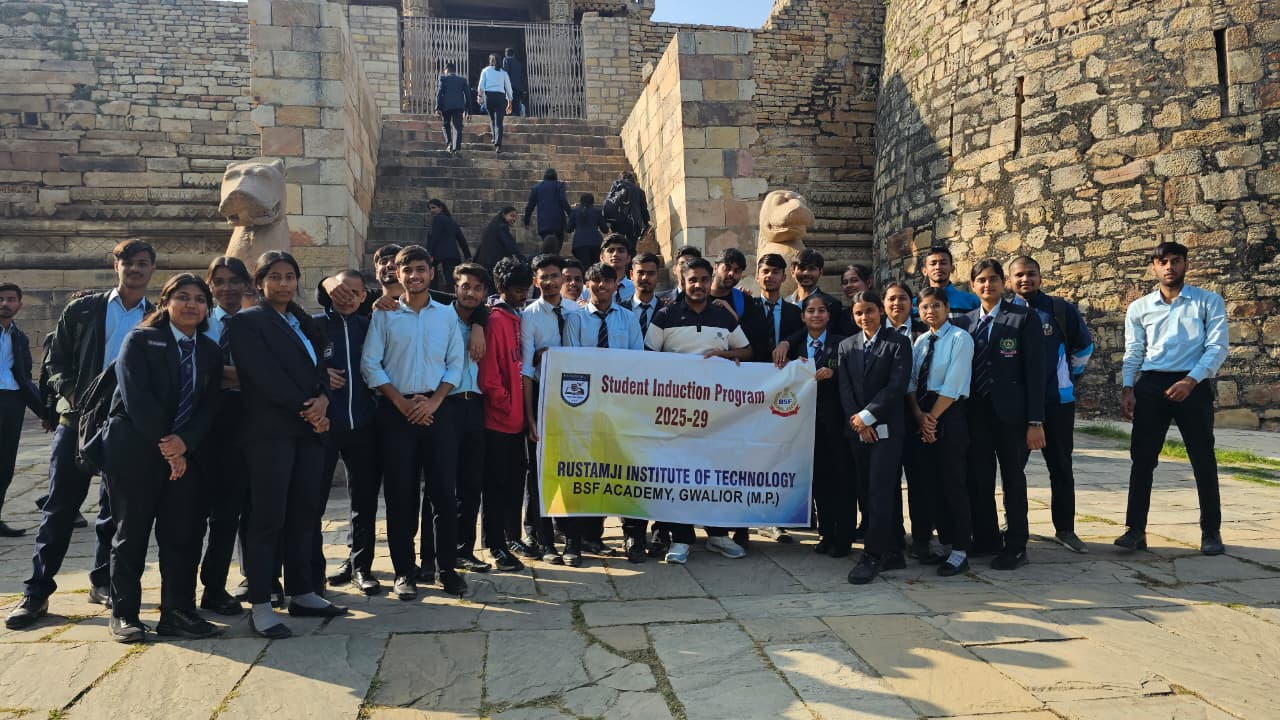
Visit To: mitawali-padavali-bateshwar
As a key feature of the Student Induction Program (SIP) 2025, first-year students of all branches at RJIT will participate in a unique cultural and historical excursion to the historically significant sites of Mitawali, Padavali, and Bateshwar.
This visit is designed to enrich the students' knowledge beyond technical studies by immersing them in the architectural heritage and ancient history of the region surrounding Gwalior.
This educational trip aims to foster an appreciation for Indian history, architectural engineering, and cultural legacy. Students will observe ancient temple building techniques and community planning, providing a tangible link between modern academic knowledge and India's past craftsmanship.
The students on the educational trip are being accompanied by a dedicated team of faculty members, whose responsibilities have been divided based on their respective departments.
The Computer Science (CS) students are under the supervision of Dr. Namita Saxena, Prof. D. Bhadoria, Dr. Rakesh Sohal, Dr. V. S. Yadav, Mr. Sumit Rajak, and Mr. Manish Prajapati. Meanwhile, the students from Electronics and Communication (EC), Automobile (AU), Information Technology (IT), Mechanical (ME), and Electrical and Electronics (EE) departments are being looked after by Dr. Manoj Sharma, Dr. S. K. Gupta, Prof. Bhavesh Rohira, Prof. Ambika Mishra, Prof. Ayushi Sharma, Mr. Santosh Shrivastava, and Mr. Manish Sharma. These faculty members are jointly responsible for ensuring the safety and successful coordination of the students from their assigned engineering branches throughout the duration of the trip.
The three sites offer distinct historical insights:
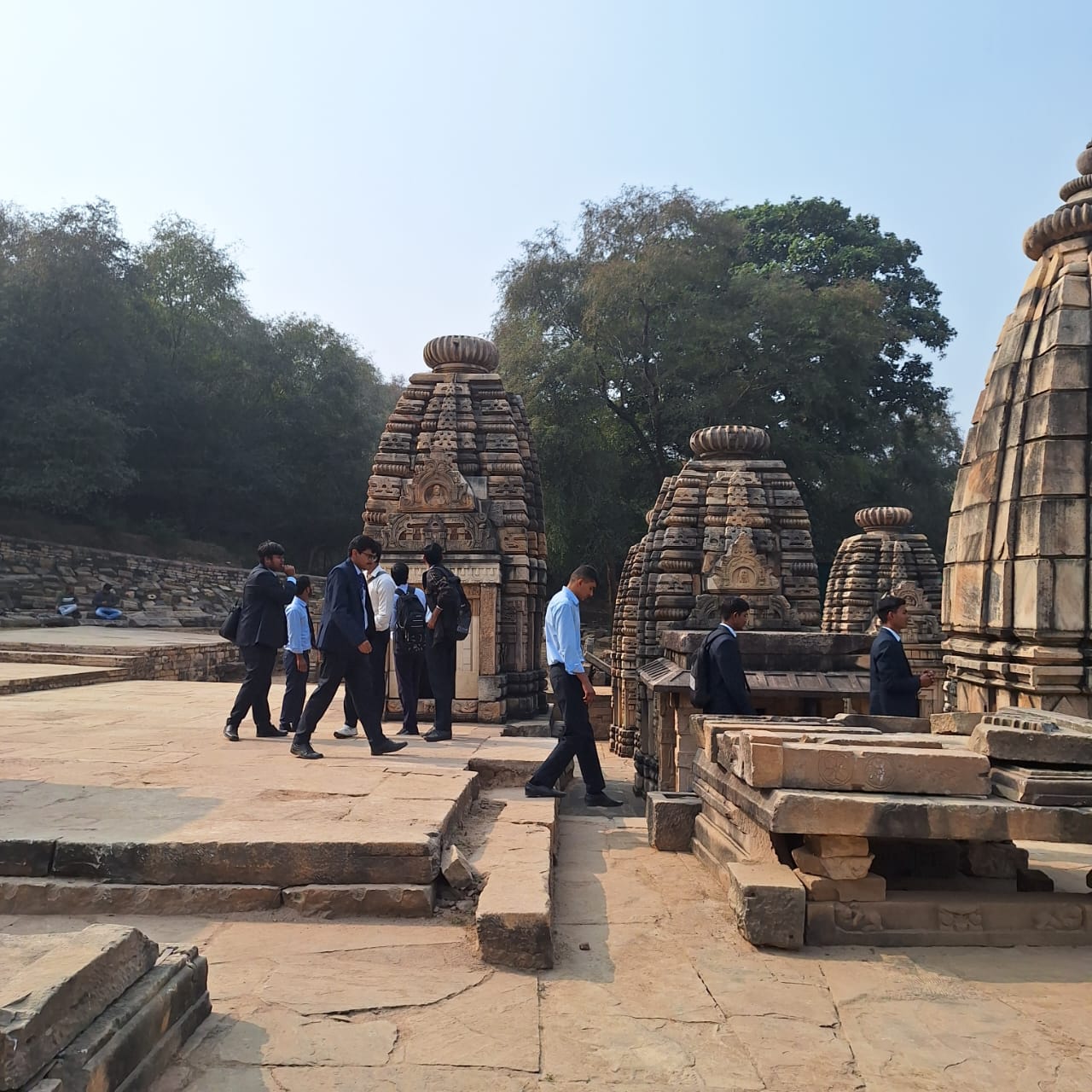
Mitawali: Famous for its circular, 11th-century Chausath Yogini Temple, believed to be a precursor to the design of the Indian Parliament building.
Padavali: Known for its ancient fort and the highly intricate carvings on its temple walls, depicting mythological scenes.
Bateshwar: An extensive complex featuring a cluster of over 200 ancient sandstone Shiva temples, showcasing varying styles of early medieval Indian temple architecture.
● Guest talk on: Leadership in a Connected World
The expert session delivered by Professor Manoj Choudhary, the Honourable Vice Chancellor of Gati Shakti Vishwavidyalaya, marked a significant intellectual highlight of the RJIT academic calendar, providing students with an invaluable, forward-looking perspective on "Leadership in a Connected World."
The lecture successfully elevated the academic discourse by directly linking engineering studies to India's national strategic goals. Prof. Choudhary powerfully articulated that modern engineering demands a holistic understanding of deeply interconnected systems, integrating traditional infrastructure like transport and logistics with advanced technologies such as AI and digital networks. He moved beyond mere technical skills, underscoring that future leaders must possess system thinking, agility, and unwavering ethical decision-making to navigate the complexities of massive public infrastructure projects.
The detailed focus on the Gati Shakti Master Plan provided students with a tangible vision of their professional future, emphasizing the national mandate to unify Railways, Highways, and Ports into a seamless logistics grid. By outlining their essential role in driving sustainable development and pioneering multimodal transport solutions, Prof. Choudhary effectively empowered the students, reinforcing the importance of teamwork, innovation, and proactive leadership.
This session served as a crucial empowerment tool, successfully aligning the students' curriculum and career aspirations with the rapidly evolving mobility ecosystem and India's goal of achieving robust, integrated, and sustainable national development. The engagement showcased RJIT's commitment to providing industry-aligned, high-impact learning experiences.
● Guest talk on: Sustainable Energy and Innovation
Rustamji Institute of Technology (RJIT) hosted a highly insightful and inspiring expert lecture by Professor Rangan Banerjee, the Director of IIT Delhi.
The session, themed "Sustainable Energy and Innovation," was a significant event aimed at orienting students and faculty toward the critical challenges and immense opportunities in the clean energy sector. Prof. Banerjee immediately set the stage by emphasizing the necessity of energy sustainability, climate responsibility, and innovation-driven growth as non-negotiable pillars for securing India's future.
Key Insights
Prof. Banerjee effectively bridged theoretical concepts with real-world application by sharing details of pathbreaking research and successful startups originating from IIT Delhi. These examples served to demonstrate the tangible impact young engineers can achieve:
Solar Decathlon: Showcased the development of fully functional solar-powered smart homes, highlighting excellence in energy-efficient architectural design and integration of renewable technology.
Lithium-Ion Battery Analysis: Detailed advanced research focused on battery performance evaluation and enhancement, underscoring the vital role energy storage plays in the transition to electric mobility and renewable grid integration.
Kitchen Waste Biogas Systems: Presented innovative, localized solutions for clean energy generation from daily waste
Call to Action and Conclusion
Prof. Banerjee concluded his address with a powerful call to action, urging the engineering community at RJIT to intensely pursue research and innovation in renewable technologies. This focus is crucial for enabling India to achieve its ambitious Net Zero Emission goals.
The session's importance was affirmed by the presence of key dignitaries: Dr. Shamsher Singh, IPS – ADG/Director, BSF Academy & Vice Chairman, RJIT. Mr. Manish Chandra – Commandant CSMT & OSD-RJIT. Dr. Prashant Kumar Jain – Principal, RJIT.
RJIT extends its heartfelt gratitude to Prof. Rangan Banerjee for sharing his valuable expertise, which successfully motivated both students and faculty to take a leadership role in advancing clean energy and sustainability initiatives.
● Guest talk By: Ms. Nivedita Raghunath Bhide
Rustamji Institute of Technology (RJIT), BSF Academy, Gwalior unique as the only engineering institute in India run by a paramilitary force (BSF) was privileged to host Ms. Nivedita Raghunath Bhide, the respected All-India Vice President of Vivekananda Kendra, Kanyakumari.
Her visit served to connect the institution's technical goals with a strong foundation in nationalistic and holistic values, which the Vivekananda Kendra promotes.
Ms. Bhide herself is a recognized social servant and author, often speaking at top institutions and having received the Padma Shri award for social service.
Interaction and Technical Appreciation
Ms. Bhide engaged in meaningful interactions with both students and faculty, offering profound praise for RJIT's distinctive environment. She specifically lauded the institute's successful integration of discipline (a core BSF value), innovation, and holistic learning. This endorsement highlights RJIT's success in merging academic rigor with character building.
During her visit, she was given a comprehensive tour of the institute's state-of-the-art technical infrastructure, confirming RJIT's focus on future-ready technologies:
Drone Technology Lab: This lab is crucial for the institute, especially given its BSF affiliation, focusing on defense preparedness and advanced research in drone applications, weaponization, and jamming systems, as evidenced by recent institutional initiatives.
Aviation Lab: This facility supports studies related to aerospace and aircraft systems, linking the technical curriculum with the broader defense and transport sectors.
Automotive Technology Lab: Ms. Bhide appreciated the practical, hands-on work happening here, particularly commending the award-winning projects developed by students in Automobile Engineering.
Ms. Bhide's visit was a significant event, serving to validate RJIT's dual mission of imparting quality technical education while firmly instilling the values of service, character, and national pride, echoing the ideals of Swami Vivekananda.

Introduction/ Background
As per the New Education Policy, we were mandated to conduct Literary activities for the first-year students as part of the student induction program which would help in the assimilation, bridging, and orientation of students to the college and program they have opted for. Activities were conducted over a span of 2 weeks.
Target Audience
1. Entire 1st-semester students who opted for various streams were part of the activities conducted (CSE-AIML/CSE-DS/CSE/IT/ECE/EEE/ME/AU/Civil).
2. Duration of Event: 08 days (From 22 September to 30th September 2025)
3. No of Participants: 320 +
The Heartfulness Essay Competition was fundamentally designed to go beyond mere writing skill assessment. The core objectives were:
Introspection: To encourage students to pause from academic routines and engage in deep self-reflection regarding their values and personal growth.
Philosophical Engagement: To promote articulation on complex, universal themes such as "Individual Evolution," "Support of Others," and "Being in tune with Nature."
Value-Based Education: To seamlessly integrate value education into the co-curricular sphere, reinforcing the institution's commitment to holistic development.
Modules: Essay Competition (2025)
The Heartfulness Essay Competition 2025 stands as an unqualified success for Rustamji Institute of Technology, setting a new benchmark for student literary and introspective engagement. Spanning eight days, the event achieved its primary objective by successfully mobilizing over 320 participants—a remarkable turnout that highlights the profound student interest in engaging with meaningful, value-based topics extending beyond the traditional curriculum.
The seamless execution of this high-profile event, in partnership with international bodies like the Heartfulness Education Trust, was entirely facilitated by the exceptional dedication of the Abhivyakti Club. Their flawless management of the logistical pipeline—from campus-wide promotion and standardized material distribution to the critical final phase of scanning and uploading over 320 individual essays—ensured the institutional process was professional, efficient, and compliant with all external competition standards.
Crucially, the entire initiative was carried out with zero financial expenditure (NIL fees, sponsorship, or cost), underscoring the power of internal resource mobilization and volunteer commitment. This financial efficiency, paired with the substantial volume of intellectual engagement, speaks volumes about the intrinsic motivation of our student body.
The competition successfully encouraged students to engage in deep self-reflection on essential themes like evolution and environmental harmony, reinforcing the college’s commitment to holistic education and ethical development. By providing a rigorous platform for thoughtful expression, this event has not only elevated the institution's standing but has also left a lasting positive impact on the participants’ critical thinking and personal development. The success of the 2025 Heartfulness Essay Competition provides a compelling model for future literary and value-based campus initiatives.
Impact and Qualitative Observation
The high volume of participation (320+ students) is a powerful metric of the event's success and the students' readiness to engage with non-technical, introspective topics.
Student Engagement: The topics selected prompted thoughtful responses, moving beyond rote learning to genuine expression. Many participants expressed appreciation for having a structured opportunity to reflect on their own moral and developmental philosophies.
Club Development: The execution of this large-scale, international event significantly enhanced the organizational and leadership skills of the Abhivyakti Club volunteers. The flawless execution with zero expenditure highlights the effective use of internal resources.
Institutional Prestige: The successful coordination of a prestigious event run in collaboration with international bodies like the Commonwealth and the Heartfulness Education Trust elevates the college's reputation as an institution that fosters holistic education and global citizenship.
Conclusion
In conclusion, the literary activities conducted as part of the student induction program were instrumental in creating a vibrant and dynamic learning environment for our new students. Tactivities not only fostered a love for literature but also nurtured essential skills and qualities such as critical thinking, effective communication, collaboration, and an awareness of the world around us. This multifaceted approach to literary engagement not only introduced our students to the world of literature but also equipped them with the skills and knowledge needed to thrive in their academic pursuits and as responsible, informed citizens.

Exposure to BSF Academy
The Student Induction Program (SIP) at Rustamji Institute of Technology (RJIT), BSF Academy, Gwalior, included an essential and highly privileged component: a visit to and practical interaction with the BSF's core operational and training wings. This exposure was designed to give students a direct, immersive understanding of the discipline, specialized skills, and national importance inherent to the Border Security Force environment they are a part of.
Key Wings Visited and Their Significance
The visit focused on highly specialized units, providing students with both theoretical knowledge and hands-on experience:
Tear Smoke Unit (TSU): Students received an introduction to the role of TSU in maintaining internal security and crowd control. They learned about the design, chemistry, and controlled application of non-lethal weapons and tear smoke munitions used by the BSF. The Tear Smoke Unit (TSU) within the Border Security Force (BSF) serves as a critical, highly specialized unit responsible for managing and neutralizing threats posed by civil unrest or large assemblies without escalating to lethal force.
TSU is tasked with the manufacturing, standardization, and quality control of various tear smoke munitions and non-lethal weapons used for crowd dispersal and area denial in volatile situations. TSU ensures that BSF personnel are equipped with reliable, effective, and ethically regulated means of maintaining internal security and border integrity. Furthermore, the unit plays a vital role in training BSF personnel and other security agencies in the proper handling, tactical deployment, and safety protocols associated with these specialized irritant agents.
Practical Engagement: The most significant part was the privilege of participating in practical demonstrations and exercises alongside the Jawans. This likely involved understanding the proper handling, deployment procedures, and safety protocols associated with tear smoke devices, offering a unique, real-world perspective on tactical operations and discipline.
Border Institute of Disaster Response (BIDR): Students were introduced to the critical and humanitarian role of the BSF in national disaster management. They learned about rapid response strategies, search and rescue operations, medical aid deployment, and the coordination required during natural calamities like floods or earthquakes.
Practical Engagement: Students were given the rare opportunity to perform hands-on disaster response drills with the Jawans. This would involve activities such as basic rescue techniques, using specialized equipment, and participating in simulated scenarios, driving home the importance of quick decision-making and preparedness under duress.
Impact under the SIP Program
Incorporating these technical and operational visits into the SIP achieved several critical objectives:
Instilling Discipline and Patriotism: Direct interaction with the Jawans—"Desh ke Jawans"—instilled a deep sense of respect, discipline, and national duty, aligning the students' values with the ethos of the BSF Academy.
Bridging Theory and Reality: For engineering and technical students, seeing the practical, often life-saving, application of technology in the TSU and BIDR contexts provided a powerful, real-world relevance to their academic studies.
Unique Privilege: The practical sessions elevated the visit from a simple tour to a privileged learning experience, leaving an indelible impression on the students about the high standards of commitment and skill required of the BSF personnel.
This component of the SIP successfully ensured that RJIT students not only begin their academic year with technical knowledge but also with a profound appreciation for the operational excellence and dedication of the forces that safeguard the nation.
♦ Engineer's Day Celebration at RJIT (SIP 2025)
Rustamji Institute of Technology (RJIT), BSF Academy, Gwalior, incorporated a significant event—the celebration of Engineer's Day—into its Student Induction Program (SIP) for the Batch 2025-2029.
This celebration was strategically designed to immediately expose the newly inducted students to inspirational thought leadership and the broader scope of their chosen profession.
The event was anchored by the highly relevant and forward-looking theme: "Unconventional Pathways: Inspiring Innovation Beyond the Obvious." The central highlight was a keynote address delivered by Professor Anil Gupta, a distinguished academic, Padma Shri Awardee, and faculty member from IIM Ahmedabad.
Prof. Gupta's presence signaled the institution's commitment to high academic standards and innovative thinking, challenging the fresh batch to look past traditional engineering roles and embrace creativity and disruption.
By holding this event within the SIP, RJIT ensured that the students' academic journey commenced not just with introductions to courses, but with a powerful message about the potential for impactful innovation and the importance of unconventional thinking in tackling global challenges. The required attendance was managed efficiently using a dedicated QR code system, ensuring seamless entry and tracking of participation for all inductees.
♦ Teacher's Day Celebration at RJIT (SIP 2025)
The celebration of Teachers' Day formed a vital and emotionally resonant segment of the Student Induction Program (SIP) at Rustamji Institute of Technology (RJIT), BSF Academy, Gwalior. This event was meticulously planned to move beyond mere formal acknowledgment, serving instead as a genuine platform for students to express profound gratitude for the teaching profession, thereby fostering a strong and respectful rapport between the new batch and the distinguished faculty.
The distinguishing feature of this celebration was the high level of student ownership and participation. Students enthusiastically volunteered for and executed a variety of engaging cultural activities designed to honor their educators:
Storytelling and Narratives: Students shared personal anecdotes, inspirational stories, and carefully chosen narratives that highlighted the profound influence teachers have on shaping careers and character. This activity emphasized the communicative skills and empathetic reflection of the incoming students.
Dance Performances: Diverse dance forms, ranging from classical to contemporary, were presented, demonstrating the artistic flair and physical talents of the new batch.
Other Cultural Activities: The program was further enriched by activities such as musical tributes, soulful poetry recitations dedicated to mentorship, and comedic skits that lightheartedly portrayed campus life and teacher dedication.
By encouraging this proactive involvement, the Teachers' Day celebration successfully achieved its goals under the SIP mandate: promoting cultural integration, providing opportunities for students to demonstrate their all-round talents, and most importantly, establishing a foundational atmosphere of mutual respect and appreciation that is essential for a productive and supportive academic career at RJIT.
◆ Bike Show at RJIT (SIP 2025)
Adrenaline and Aspiration: The BSF Bike Show at RJIT
A highlight of the Student Induction Program (SIP) 2025 at Rustamji Institute of Technology (RJIT) was the spectacular and inspiring Bike Show, conducted by the Border Security Force's (BSF) Central School of Motor Transport (CSMT) teams. This thrilling display was strategically incorporated into the induction schedule to showcase the BSF's commitment to discipline, precision, and national service—values deeply relevant to the RJIT environment.
The Performers: Janbaaz and Seema Bhawani: The show featured two internationally renowned BSF motorcycle demonstration teams:
Janbaaz (Men's Team): The male riders demonstrated extraordinary coordination and bravery.
Seema Bhawani (Women's Team): This groundbreaking women's team delivered an equally powerful performance, emphasizing skill and determination.
Both teams comprised 28 skilled riders each, executing complex, high-risk maneuvers that require intense concentration, physical strength, and perfect synchronization.
Focus on Skill, Safety, and Empowerment
The performance was expertly led by Inspector Vishwajeet Bhatia, who guided the display and ensured the messaging resonated with the students:
Discipline and Skill: The riders performed breathtaking feats—such as human pyramids, intricate formations, and daring stunts—which served as a visible testament to the levels of discipline, rigorous training, and courage that define the BSF forces.
Safety Awareness: Inspector Bhatia used the platform not only for entertainment but also for essential education, delivering a crucial address on safe driving practices and responsible road behavior, a practical life lesson for the incoming batch.
Women's Empowerment: The performance by the Seema Bhawani team was particularly impactful, serving as a powerful demonstration of women's active role in serving the nation which inspired female students towards leadership and professional excellence.
